Share

Politics of Parenthood

Share

About

Representation matters—in government and in data. Vote Mama Foundation is the only organization tracking the number of moms with minor children serving in Congress and state legislatures across the country.

Parenthood status is an important identity for Americans—it shapes everything from how they spend their time to how they think about the world. Yet, while there has been substantial research looking at other identities in political representation, such as race, gender, and sexuality, no one was the examining parenthood status of elected officials—until Vote Mama Foundation launched our Politics of Parenthood series.

If you’ve ever seen Congress’ inaction on paid family leave or affordable childcare, and you’ve asked yourself the next logical question, “How many members are moms?” you don’t have to wonder anymore. Vote Mama Foundation has the answer.
About the dataset

Our Politics of Parenthood dataset identifies the parenthood status of all 541 U.S. Senators, U.S. Representatives, and non-voting members of Congress. We also measure the number of moms with minor kids serving as governors and state legislators in all 50 states.

We aim to provide nuanced and accessible data that can be used for both research and public communication. Because we rely on publicly available information, we do not consider our dataset to be exhaustive. However, to the best of our knowledge, it is the largest and most accurate dataset of American legislators’ parenthood status.

Our Politics of Parenthood dataset includes:

  • All members of the 119th Congress as of February 2025
  • All state legislators serving in office as of February 2024
  • All members of the 118th Congress as of April 2023
  • All state legislators serving in office as of August 2022

About parenthood status

We define parents of minor children as individuals with biological, foster, step, and formally or informally adopted children under the age of 18. Mamas are cis and trans women with biological children, foster children, step-children, or formally or informally adopted children under the age of 18. We refer to mamas interchangeably as moms of minor kids or mothers of minor children.

About representation

We evaluate representativeness in terms of nationwide population. We consider equitable representation to be achieved when the share of a demographic in a legislature is similar to that of the adult population in the United States. Unless specifically noted otherwise, all population-level statistics are derived from the 2022 American Community Survey (ACS) 5-year Estimate Public Use Microdata.

“Everything I do is for the future of not only my own son, but for the future of all of our families. I’m a Mom on a Mission to ensure that he can go further in life than I did and that he has the opportunity to fulfill his version of the American Dream.”

Rep. JoAnna Mendoza (Candidate for U.S. House)

Key Findings

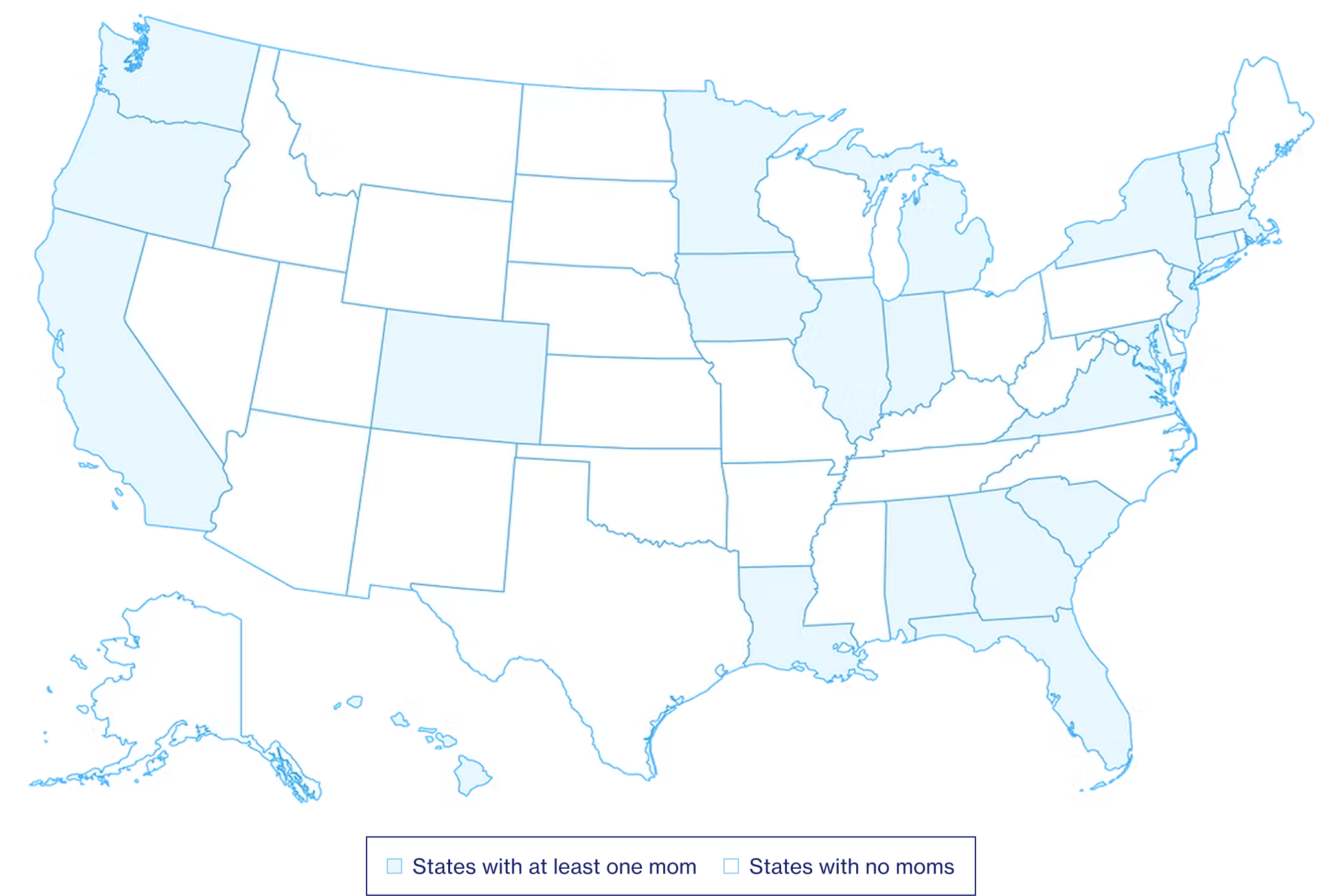
29 states have no mamas of minor children representing them in Congress.

763

more moms with kids under 18 are needed to achieve proportional representation in state legislatures

7.9%

of all state legislators are moms of minors

8.3%

increase in representation from the 118th Congress

7.2%

of members of the 119th Congress are moms of minor children

29 states have no mamas of minor children representing them in Congress

Figure: representation of moms of minors  in Congress

Federal

Just 7.2% of the 119th Congress are moms of minor children, despite moms of minor children making up 18% of the adult population.

State Legislatures

In 2024, only 7.9% of all state legislators are moms of minor children. In order to achieve proportional representation, Americans need to elect 763 more moms of minor children to state legislatures.

Statewide

Vote Mama Foundation has compiled the first-ever dataset tracking the number of moms with minor children serving as governors across the United States. This work builds on our groundbreaking Politics of Parenthood series and opens the door to new conversations about who holds executive power in the United States.